
Searching Buffalo County Criminal Dockets
Your first stop is the Wisconsin Court System Case Search page. It points circuit users to Wisconsin Circuit Court Access, known as WCCA. Choose Buffalo County first. Then search by name, exact case number, filing range, case type, prosecutor, issuing agency, or citation number. The case number works best, since names repeat across files. Buffalo County felonies carry a CF prefix. Misdemeanors use CM. Both follow the statewide year-type-sequence convention. Keep your filters light. Stack on too many, and the right Buffalo County criminal docket can slip out of view. The portal may ask you to pass a human-verification check, and it bars automated scraping.
- Open WCCA and accept its public-use notice when shown.
- Select Buffalo County, then enter an exact case number or party name.
- Narrow by CF, CM, or criminal-traffic type when needed.
- Open the match and sort court record events by date.
- Confirm future activity and ask the clerk for filed documents.
The official WCCA interface shows where a public Buffalo County criminal docket search begins.
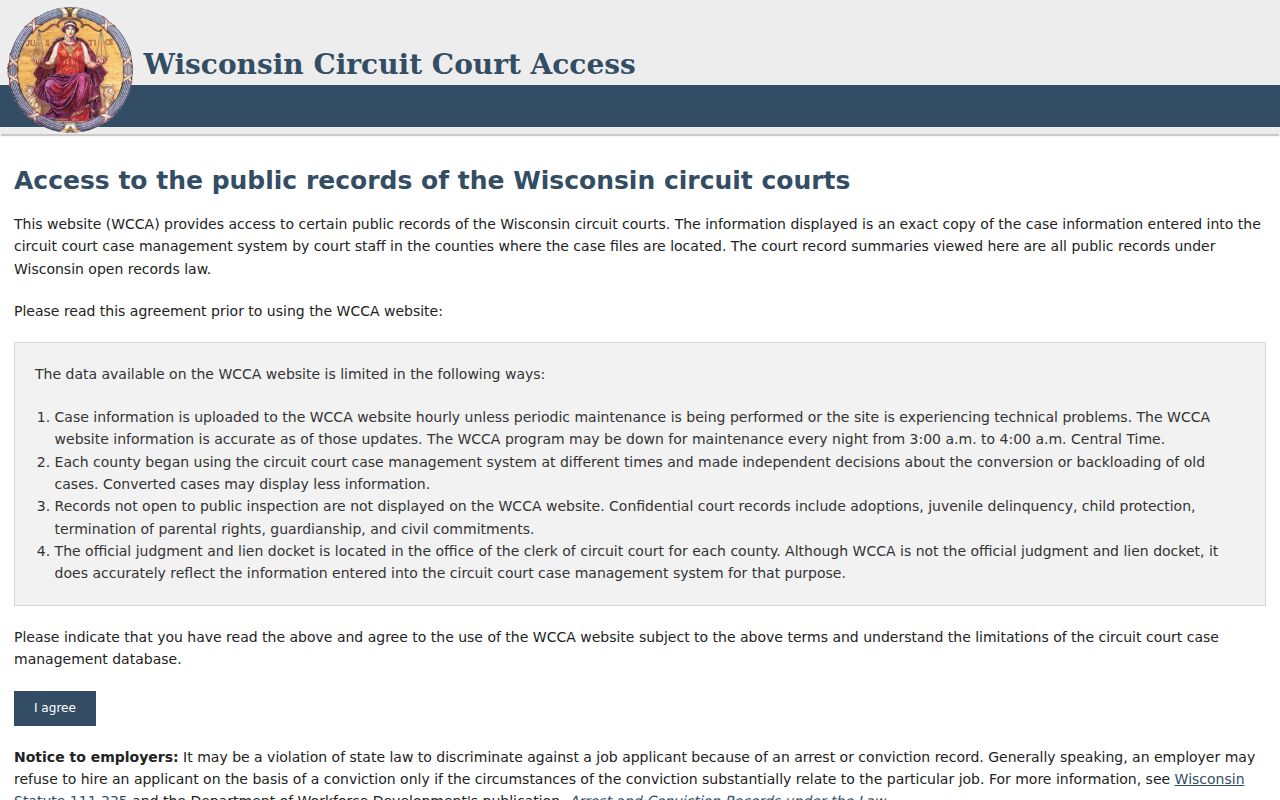
The portal is only the starting point. Buffalo County remains the place to request the actual record behind any event listed there.
Buffalo Criminal Case Numbers
A circuit case number stacks three things together. It carries the filing year, a case-type code, and a sequence number. You may see it written without punctuation, such as 2026CF000123. CF marks a felony, and CM a misdemeanor. A TR or FO code can point to traffic or forfeiture. That differs from a standard felony or misdemeanor docket. The district attorney number is a different animal. It only tracks the file inside that office. It should not replace the circuit case number in a WCCA lookup. Before opening a result, compare the county, filing year, type, and sequence. Otherwise a similar name may pass as the same Buffalo County criminal case.
Inside a Buffalo County Criminal Docket
WCCA labels each dated entry a "court record event." Those events build the public timeline of a criminal docket. A line may note when a complaint was filed. It can also mark a hearing or an entered order. The result also shows a branch, filing date, status, charge rows, and public sentence or judgment details.
| Case number | The Buffalo County year, criminal type, and unique sequence. |
|---|---|
| Charge row | Count, statute, description, severity, and charge-level disposition where public. |
| Court record events | Dated filings, appearances, hearings, motions, orders, and outcomes. |
| Future activity | The next date, time, setting type, and available court assignment. |
| Case status | Overall case state, which may differ from the outcome of one charge. |
A closed label usually means a final judgment was entered. Later activity can still land in the file. So read the full event list and every charge outcome rather than trusting one status field.
Buffalo Criminal Docket Terms
Short labels repeat across Wisconsin criminal records. Where a label sits in the event sequence matters as much as the word itself.
- Initial appearance
- The first scheduled court contact after a criminal case is filed.
- Arraignment or plea
- The stage at which a plea is entered to the charge.
- Pretrial or status conference
- A case-management setting before a plea or trial.
- Disposition
- The result of a charge, such as conviction or dismissal.
- Continuance or reset
- A change that moves a court setting to a later date.
Severity and disposition live in separate fields. A motion entry is only a request, never proof the motion was granted; the later order or ruling does that.
How a Criminal Case Moves
Most cases move in stages. The route bends with the charge and each ruling. Reading the event list in order lets you follow a Buffalo County case without assuming every setting is a trial.
Docket flow: Filing › Initial Appearance › Arraignment or Plea › Pretrial Activity › Plea or Trial › Disposition › Sentencing
A continuance adds a new date. The old event stays on the docket. Warrants, motions, amended charges, payments, and notices of appeal can appear too, and after any reset the newest event is the one to confirm with the clerk before you travel.
Buffalo Criminal Events Versus Documents
A WCCA line is not the document itself. It is not the complaint, motion, order, exhibit, or transcript on file. WCCA offers no download library of public case documents. The Wisconsin eFiling FAQ explains where public case information ends and document access begins. Call the Buffalo County Clerk of Circuit Court. Give the case number plus the exact document title or event date. The clerk handles inspection, plain copies, and certification. Parties and lawyers with authorized eFiling accounts get broader document access, though eFiling is not a substitute public portal.
Courts That Hold Criminal Dockets
The Wisconsin Circuit Court for Buffalo County holds the county's felony, misdemeanor, and criminal-traffic dockets. Wisconsin keeps one circuit level of general jurisdiction. So Buffalo County does not split felony and misdemeanor files between a county court and a district trial court. The Buffalo County Clerk of Circuit Court maintains the case files and proceedings. Municipal courts may hear local traffic, parking, ordinance, and limited first-offense matters. They do not replace the circuit criminal docket. Buffalo County has no municipal-court website in the state directory. Appeals go to the Wisconsin Court of Appeals District III, searched through WSCCA. A notice of appeal may sit in WCCA. The appeal itself runs under its appellate number.
Buffalo Criminal Records at the Clerk
Start any Buffalo County criminal docket search with the Buffalo County Clerk of Circuit Court. It is the office that keeps the local case files. There are several ways in. You can search WCCA from home, sit down at a Courthouse WCCA terminal, ask at the counter, call 608-685-6212, or mail a written request to P.O. Box 68, Alma, WI 54610. Before faxing anything to 608-685-6211, confirm the office still accepts faxes. The office publishes no general email address for criminal record requests. Plan on one of the other channels.
The clerk sits at 407 S. 2nd St., Alma. When you request a court record, include the filing year, the party or case style, and the case type. Add the case number if you have it, plus the document you want. Some older files predate CCAP entry. Others were never back-loaded into the system. The clerk can still check paper or other stored records for them. The official clerk page lists the court services and the full contact block.
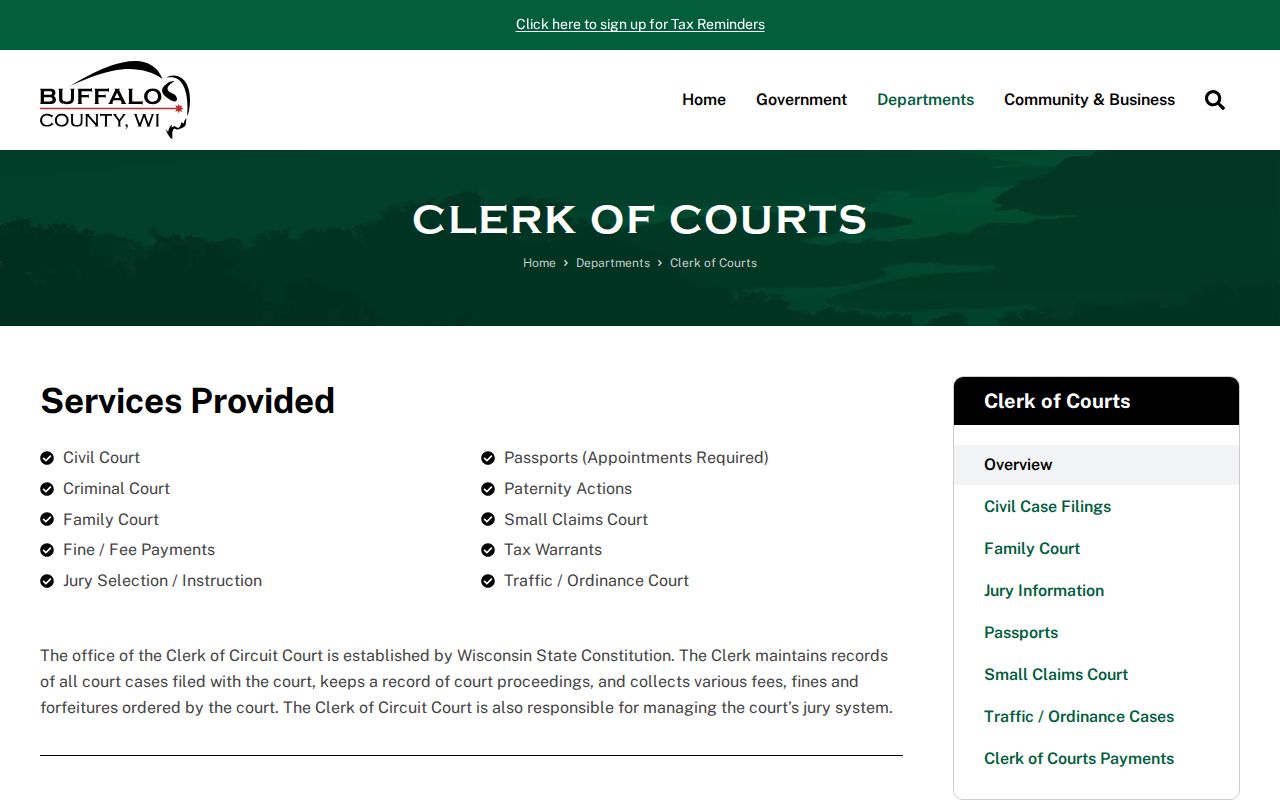
This is the office that ties a single Buffalo County criminal docket entry to the whole public case file behind it. Call before you mail anything. Confirm the copy cost, whether you need a certified copy, what payment the clerk takes, and that the criminal file you want is on hand.
Sealed Dockets and Public Access
Wisconsin leans toward openness. Even so, a Buffalo County criminal docket can hold back sealed or confidential material, along with juvenile, victim, witness, juror, and protected financial details. A slim docket display is not proof that no court file exists. More often, law or a court order has simply narrowed what the public may see.
Key Wisconsin rules:
Wis. Stat. § 19.31 states the public-record policy. Wis. Stat. § 801.20 addresses protected circuit-court information. Wis. Stat. § 801.21 governs motions to seal or redact records.
The Wisconsin court redaction resource illustrates the boundaries placed around public displays.
Those rules shield the sensitive details only. Ordinary public criminal docket events stay open through the proper channel.
When a Buffalo Criminal Date Is Missing
Start simple. Clear the extra search fields and make sure Buffalo County is the county chosen. Then try the exact circuit case number, or a last name paired with the right criminal type. Scan the court record events for a fresh continuance or anything scheduled ahead. Is the case on appeal? Use WSCCA instead. For a federal matter, WCCA is simply the wrong system.
Still stuck on a Buffalo County criminal court date? Call the Clerk of Circuit Court at 608-685-6212. Have the case number, the rough filing year, and the date on your notice ready. A clerk's word or a current court notice beats an old web entry whenever the two disagree.