
Searching Buffalo County Civil Dockets
Wisconsin's official case-search page points searches to Wisconsin Circuit Court Access, known as WCCA. For a Buffalo County civil docket, that system is the main online stop. A case number works best. Without one, type a party or business name and pick Buffalo as the county. Keep the search lean at first. Stacking too many fields can bury a good match. WCCA may show a public-use notice and a human-verification control before you proceed. Accept it, then check county, case type, filing date, and status before opening a result. Civil numbers often look like YYYYCV######. Small claims use YYYYSC######. Whatever number appears on a clerk record or official notice wins.
- Open WCCA and accept its public-use terms when shown.
- Enter the case number, party name, or business name, then choose Buffalo County.
- Use civil, small claims, family, or another fitting case type only if more narrowing is needed.
- Match the county, filing date, case type, and status before opening the case.
- Read court record events by date, then contact the clerk for any document or certified judgment.
Buffalo Civil Events, Not PDFs
One common slip in a Buffalo County civil docket. People read an event label as the paper itself. WCCA may say a complaint, motion, order, or judgment was entered. It does not supply public images of those documents. The event only proves the court recorded an action. The Buffalo County Clerk of Circuit Court holds the paper behind it. The official WCCA interface appears in the public-access view below. Its statewide reach means the Buffalo county filter really matters, since common names multiply fast.
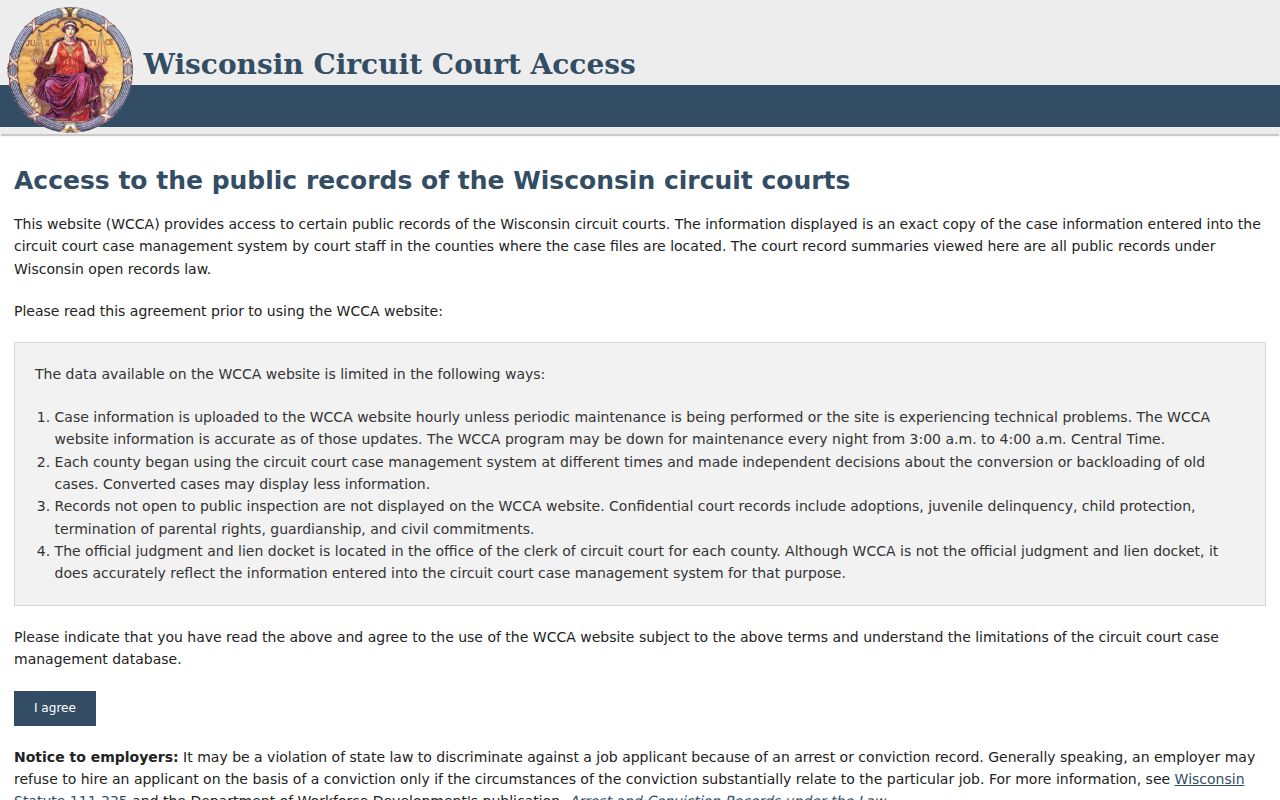
That interface opens the door to public case information, nothing more. For file inspection, a plain copy, or a clerk-certified copy from Alma, the clerk's office remains the answer.
Inside a Buffalo County Civil Docket
A civil case detail page pairs a header with a dated event list. Read the whole run of entries rather than one line. A single event rarely tells the full procedural story. A closed status does not rule out later post-judgment activity. WCCA's own eFiling material describes closed, in general terms, as final judgment entered.
| Case number | County, year, case-type code, and sequence used to distinguish the file. |
|---|---|
| Parties | Plaintiff, petitioner, defendant, or respondent roles, with public attorney data where entered. |
| Case header | Filing date, case type, status, caption, and branch or court information. |
| Court record events | Dated entries for pleadings, service, motions, hearings, orders, judgment, satisfaction, and appeal activity. |
| Judgment block | Judgment date, judgment parties, and public money or satisfaction information when available. |
| Future activity | Hearing date, time, and activity when entered; recent changes should be confirmed with the clerk. |
Money and balance fields are never the whole financial file. A judgment line, likewise, is not a certified judgment. Use the event list to learn what exists, then ask the clerk for that exact item by name.
Find Buffalo Civil Cases by Name
No case number? Run the name search with Buffalo selected. Businesses get their own field. Start with the last name alone, then add a first name or filing range if the results balloon. Alternate spellings and former names can change everything. A blank result does not prove the case never existed.
| WCCA field | Best use | Practical limit |
|---|---|---|
| Party name | Find an individual party without a case number | Common names may need Buffalo and a case type |
| Business name | Find an organization named in a civil case | Use the filed name or a close variant |
| County | Narrow statewide results to Buffalo | A case filed elsewhere will not appear in this county set |
| Case type | Separate civil, small claims, family, and related matters | Restricted types may show little or nothing |
| Filing range | Focus on an estimated year or span | No official maximum range was found in the research |
When online searching stalls, the clerk can search by hand. Give an approximate year, the party style, and the case type. Wisconsin's fee schedule sets a $5 search charge per action. That applies when no case number is supplied. Confirm the current cost and how to pay before mailing anything.
Civil Case Types on the Docket
The Buffalo County civil filing page lists what comes through: foreclosures, money judgments, name changes, personal injury, real estate matters, restraining orders, and more. Small claims and evictions sit in circuit court too, under Wisconsin's unified system. No separate justice court takes them.
- CV civil: ordinary civil actions such as contract, tort, foreclosure, or real estate disputes.
- SC small claims: lower-value claims and evictions within Wisconsin's statutory route.
- FA family: family proceedings, with privacy limits that may narrow the public display.
- PR probate: probate-related files routed through the Register in Probate where appropriate.
- FO forfeiture: ordinance or forfeiture matters that can appear on a civil-branch path.
The state fee chart caps small claims at $10,000, and filing totals for other civil cases shift with claim type and amount. Those figures describe routes into court. They say nothing about what a pending case is worth or how it will end.
Buffalo Civil Docket Event Terms
Event labels mark steps, not verdicts on the merits. Read them in date order, and watch whether a later entry revises an earlier setting or judgment. The terms below mark common points along the Buffalo County civil docket trail.
- Complaint or petition
- The paper that starts a civil proceeding or asks the court for relief.
- Service
- An entry about delivery of formal notice, often supported by proof of service.
- Motion
- A party's request for a ruling before or after judgment.
- Order
- A court directive. The docket can list it even though WCCA does not display the document image.
- Judgment
- The court's formal adjudication, which may include a money judgment.
- Satisfaction
- An event showing that a judgment was paid, satisfied, or otherwise resolved in the docket.
A notice of appeal can also land on the circuit docket. The full appellate record then lives in Wisconsin Supreme Court and Court of Appeals Case Access. Buffalo County appeals route to District III.
Civil Docket Settings and Hearings
Civil settings cover a lot of ground: return dates, scheduling conferences, status conferences, motion hearings, bench trials, jury trials, reviews, and other court activity. A return date or scheduling event is not automatically the trial. Pair the activity name with the details. Check the date, time, judge or court official, location, and neighboring events. A continuance or reset should show up as a new event. It may also appear as an updated future activity. Trust the newest entry. If a mailed notice clashes with WCCA, call the Buffalo County Clerk of Circuit Court at 608-685-6212 before you drive. Do the same when the location sits blank. The Buffalo County court dates reference walks through the fuller procedure. Family, probate, guardianship, and protective-placement hearings may display less to the public. A visible case number does not open every hearing detail or paper. Ask the clerk or Register in Probate what may lawfully be inspected.
Buffalo Civil Copies and Certification
Copies of Buffalo County circuit case files come from the Clerk of Circuit Court. Visit the office at 407 S. 2nd St., Alma, WI 54610. Mail goes to P.O. Box 68, Alma, WI 54610 once you confirm the request and payment method. Phone 608-685-6212. Fax is 608-685-6211.
The official clerk page posts the copy rate: $1.25 per page. Certification adds $5 per case number. A plain copy just lets you read the filing. A certified copy carries the clerk's attestation. State fee materials also list a $5 per-action search fee. That applies when no case number is supplied.
Name the record precisely. Give the case number, type, filing year, exact event or document, and whether the copy must be plain or certified.
Before mailing or faxing a request, confirm the clerk accepts that channel and whether prepayment is required. The county offers no dedicated web form for certified copies, and turnaround times are not fixed. Public eFiling serves parties and authorized filers only. It cannot replace a public copy request.
Civil Docket Access Rules
Wisconsin tilts toward access, with limits. Wis. Stat. §19.31 lays out the open-records policy. §19.35 covers inspection, copies, fees, and restrictions. Send a circuit case request to the Clerk of Circuit Court, not the Buffalo County Clerk, who keeps county-government records.
Court-record limits: Wis. Stat. §801.20 addresses protected court information, while §801.21 provides the procedure for a motion to seal or redact.
Confidentiality limits reach many case types. Family, juvenile, guardianship, commitment, medical, financial, and identifying-address data may be sealed, redacted, or coded. A limited WCCA header does not open the full file. The clerk might issue a redacted public copy. Or an order may be needed before a certified record is released.
Buffalo Civil Docket Fallback Chain
Each access route fills a different need. WCCA gives a free event index. A Courthouse WCCA terminal offers the same public system for visitors without online access. The clerk counter handles file inspection, copies, and certification. It also holds older retained files. Those may never have been back-loaded into CCAP.
Call the clerk to route a date or file question. Confirm mail or fax terms before sending anything in writing. Probate and related protected matters go through the Register in Probate. Once a notice of appeal is filed, WSCCA carries the appellate docket. Wisconsin Circuit Court eFiling exists for parties, attorneys, and authorized users. It is not general public document-image access.
When WCCA returns nothing, the cause may be an old paper file. It may also be a spelling problem, another county, a restricted case, or a municipal or federal venue. Rule those out before deciding no Buffalo County civil record exists.
Note: WCCA is the event index. The Buffalo County Clerk of Circuit Court remains the source for filed civil documents.